Press Reports
Press Reports
Our Press Reports
“Destroying Goods Is Not a Desirable Option for Us”
As GLAESER Group, you operate in various fields, supplying sectors such as industrial hygiene and agriculture. You recycle used textiles and produce polyester fibers with Märkische Faser. In addition, you sell fabrics, haberdashery, and home textiles in your own stores and even sewing machines through stoffe24.com. What role do used clothing collection and surplus material recycling play in your business model?
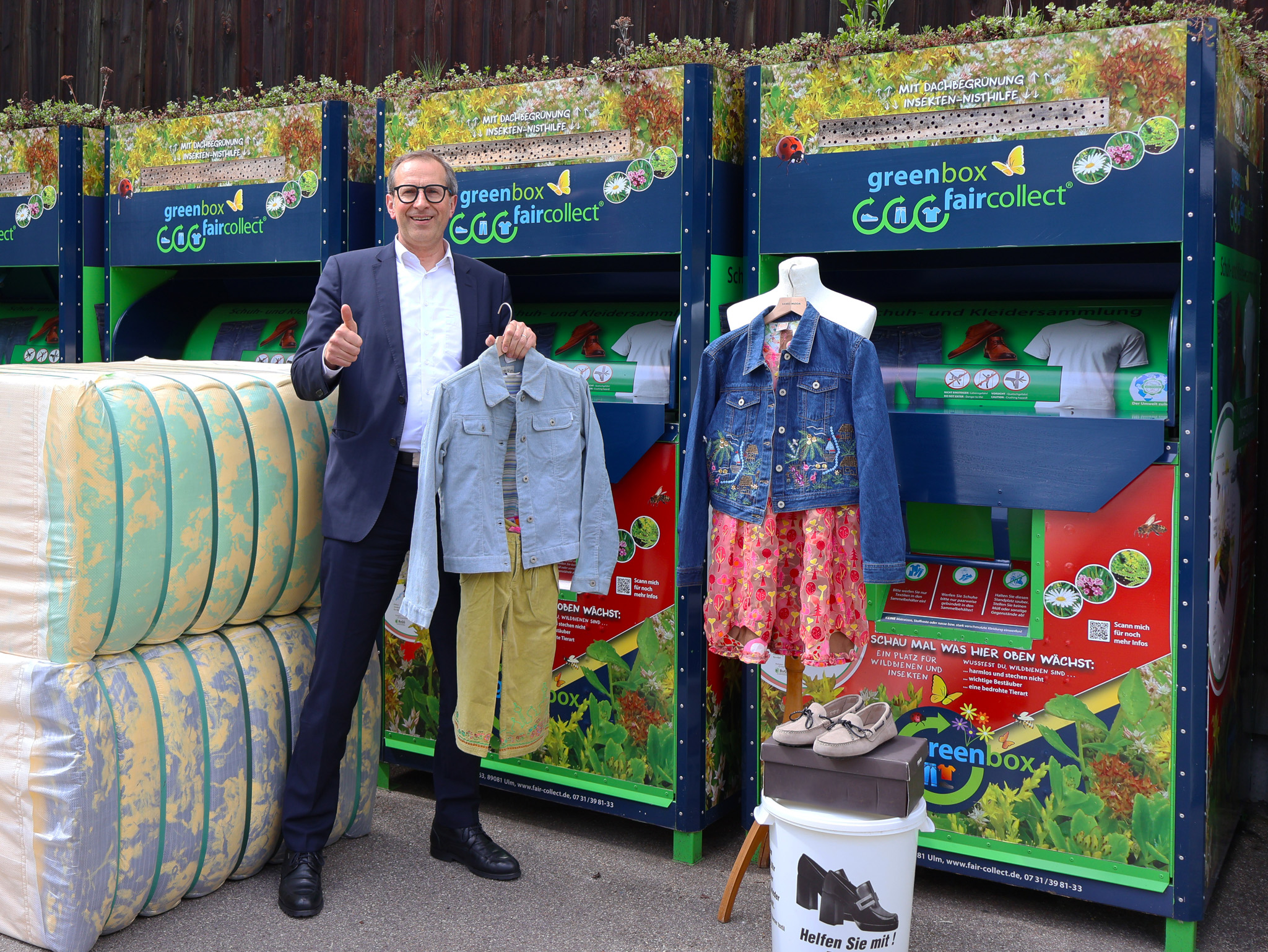
Recycling is the DNA of our company, from which everything has developed. When our company was founded in 1888, we only dealt with waste from the clothing industry. We collected these materials from manufacturers in the Swabian Alb region and created all kinds of products from them. At some point, my father also began taking in second-choice knitwear and woven fabrics from textile manufacturers. The knitwear business developed into a division that now focuses on hygiene products and, together with a subsidiary in Bremen, produces disinfectant textiles for clinics, for example. For woven fabrics, we developed a retail approach. And from a charitable activity started by my father, used clothing collection emerged. Today, we have around 2,000 used clothing and shoe collection containers installed, including our newly developed greenbox model — collection containers with insect nesting aids and green roofs. Finally, 20 years ago, we acquired a large chemical company in Brandenburg, Märkische Faser.
Out of insolvency.
Yes. Everyone thought we were crazy, saying that producing in Germany was pointless and so on. But I already know that I am a little crazy; nobody needs to tell me that now. Our vision was simply to be better than the Chinese. And to use the “raw materials” we have here in Germany: waste. That is how we entered recycling and, for example, processed PET bottles into fibers.
With so much merchandise currently on the market, you should not run out of supply. Think of Shein and Temu. There is concern that, due to US tariffs, Chinese companies may now push even more goods onto the European market at dumping prices. The market is being flooded. We have reached the point where used clothing collection is collapsing and collection containers are being removed. The industry is in crisis. A leading provider such as Soex has even had to file for insolvency. How can this happen?
The increased supply leads to falling prices for used goods. Recycling often no longer pays off. The problem is that textiles are made from so many different materials. Conventional textile recycling ultimately only results in downcycling. From many items, I can only produce insulation materials or cleaning cloths.
“Destroying goods is not a desirable option for us as resource preservers. In my opinion, this should be prohibited or at least morally condemned. It is better to organize re-use in a meaningful way.”
How does your company deal with this?
In addition to recycling, we are actively promoting re-use. Destroying goods is not a desirable option for us as resource preservers. It cannot be that products created through value generation and carrying an ecological footprint are burned for marketing reasons or out of convenience. In my opinion, this should be prohibited or at least morally condemned. It is better to organize re-use in a meaningful way.
Do you know the extent to which goods are being destroyed?
No. But unfortunately, it does happen. Even municipalities reportedly admit privately that they burn items from used clothing collections because resale is currently very difficult.
Years ago, I was on a stage with the former CEO of Louis Vuitton and asked him what they did with unsellable products, which every manufacturer has. His answer was: “We destroy them.” To keep the sales channel clean.
Yes. That is crazy. It is an enormous destruction of assets, raw materials, and resources. That is why we advocate for re-use.
What do you mean by that?
We resell the goods — collected used clothing as well as unsellable new goods from manufacturers and retailers. For example, to Africa.
This practice is also viewed critically by some because it can flood local markets and displace local producers.
Today, far more people in Africa are involved in altering and tailoring used clothing than have ever worked in the textile industry. These people are not working at looms, but they are active in logistics, tailoring, and finishing used clothing and newly manufactured garments.
Well.
My point is that if companies have made the decision to produce goods, they also have a responsibility for those goods. So why not give these products a second life? That is certainly better than burning them.
It is not only about second-hand goods. Do you also process new goods?
The business with new goods is becoming increasingly important for us. These include industrial surplus, excess stock from retailers, and goods from business closures that we purchase. Of course, not at the prices originally expected. But before these items are discarded somewhere, we have channels where they can still be put to meaningful use.
What prices per kilogram can be achieved?
That depends. It ranges from €0.50 to €10 per kilogram — and for the best premium goods from very high-quality brands, even more. Ultimately, resale also provides interesting tax depreciation benefits for the sellers.
And you ship these goods to Africa, and the branded products then return through the grey market to retailers like Kik & Co.?
I am very sure that the goods do not come back. Container shipping costs money as well. We sell in comparatively small quantities, so it is not worthwhile for large-scale re-importers.
“For me, the Green Deal is largely greenwashing and completely hostile to industry. Much of it is simply not feasible.”
Some see the solution to the recycling problem in new technologies.
That is why, as a group of companies, we continue to focus on used clothing collection and the processing of new goods. This is our access to raw materials. I can imagine that in five or ten years, the industrial processing of blended fabrics may also become possible.
Aren't there already some initial approaches? They are just too expensive at the moment?
That is exactly the problem. But I assume that this will continue to develop.
What do you think about the regulations that have already been adopted by the EU?
For me, the Green Deal is largely greenwashing and absolutely hostile to industry. Unfortunately, I have to say that. Much of it is simply not feasible. You may know the joke that was circulating about the traffic light coalition two or three years ago?
Tell us.
What happens if the power goes out? The traffic lights no longer work, and the right-before-left rule applies … I am not necessarily a supporter of political “right before left.” But we must not overdo green regulation either. We simply need a clear approach that is also realistic. Why do some clothing products have to consist of such a mixture of materials? Cotton, viscose, various foam products, metal, fasteners, zippers.
Because the materials serve a function?
As a polyester expert, I say: You could make a lot of things from polyester. Then I put it into a machine, melt it down, and it is done. If manufacturers were required to present a recycling concept for every product, we might make more progress.
How confident are you that we will achieve better solutions in the next five to ten years?
I am naturally a hopeless optimist.
Eberhard Brack is Managing Partner of Heinrich GLAESER Nachfolger GmbH. The family-owned company has specialized in textile recycling since 1888 and develops products in the areas of fabrics/home textiles, industrial and washroom hygiene, as well as textile raw materials (fibers and yarns). GLAESER purchases surplus stock and leftover materials from industry and retail. The company collects used clothing in more than 2,000 green boxes, mainly installed in southern Germany. In its own tearing facility in Ulm, it produces shoddy wool, shoddy cotton, shoddy viscose, shoddy polyester, shoddy acrylic, and shoddy polyamide. The company also produces cleaning cloths for industrial applications at its cutting facility in Blaustein. A subsidiary operates a chain of retail stores offering mainly fabrics and home textiles. The company also includes the polyester yarn manufacturer Märkische Faser near Berlin. The group, headquartered in Ulm, employs 550 people at 14 locations and generates annual revenue of around €100 million.
Circular Concept for Public Clothing Collections
With “faircollect,” Heinrich Glaeser Nachf. supports cities and municipalities in the proper disposal of used textiles and shoes. The company’s commission-based rental system includes the installation of collection containers, their emptying, and the professional recycling of the items deposited. Thanks to this convenient overall concept, municipalities ensure proper disposal of used clothing, promote resource recovery, and protect the environment. They reduce the administrative effort associated with collection while generating additional revenue for municipal budgets. Ensuring reliable waste management is one of the key responsibilities of cities and municipalities.
In addition to the environmentally responsible disposal of household and commercial waste, municipalities are also required under the German Circular Economy Act to return recyclable materials to the economic cycle. With its “faircollect” rental system, Heinrich Glaeser supports responsible authorities in collecting used textiles and shoes. In return for a site rental fee, the company places modern collection containers at designated locations, empties them according to an agreed schedule, and guarantees proper recycling or reuse.
Even during challenging periods, such as the COVID-19 pandemic, the company continues servicing the containers and guarantees uninterrupted disposal security for its public and private waste management partners.
“Our overall concept offers important advantages for municipal waste management,” explains Christian Denning, the person responsible for “faircollect” at Heinrich Glaeser. “Through targeted collection, we keep discarded clothing and shoes away from incineration and landfill, reducing pollutant emissions and protecting the environment. We continue processing the collected materials by keeping reusable items in circulation for longer and recycling materials that can be processed further.
In our shredding facility, we also recover fiber raw materials. Thanks to various recovery systems, important resources are conserved that would otherwise be required for textile production chains and shoe manufacturing. With the amendment of the German Circular Economy Act, this argument is becoming increasingly important for cities and municipalities.”
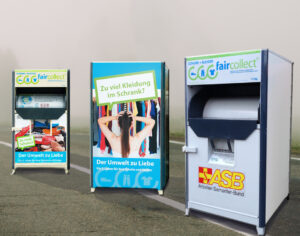
For the collection of used clothing and shoes, Heinrich Glaeser Nachf. rents out a standard container that received the German Design Award in 2018. It features two deposit openings: one extra-large opening at standard height and another opening at a convenient height for wheelchair users. The containers can optionally be equipped with a roof structure that can be used as advertising space.
The purchase of used clothing and shoes from municipalities that operate their own collection systems is the second pillar of “faircollect.” Heinrich Glaeser Nachf. collects these materials directly from waste management companies and takes care of their professional recycling. This service is also available to retailers, manufacturers, and large-scale consumers who want to dispose of surplus stock and excess production.
Source: www.recyclingmagazin.de (04/04/2022)
Fire Departments Can Earn Money with Used Clothing
In 2021, various aid organizations, including fire departments, were able to sell unneeded used clothing donated for flood victims to Heinrich GLAESER Nachf. GmbH through its faircollect collection system. The financial resources that were freed up as a result could then be used effectively elsewhere for flood relief efforts. However, faircollect is not only a reliable partner for fire departments in such emergency situations.
Used clothing and shoes can be collected through street collections (for example, in combination with waste paper collections) or by installing used clothing collection containers provided by faircollect. Faircollect reliably purchases the collected materials at market-based prices, ensuring that no one is left with the goods and that regular income can be generated. Such clothing collections can also take place in cooperation with the respective municipality, which can help arrange locations for collection containers. These locations can then generate either a commission or an annual placement fee.
Faircollect has developed a unique collection container with a lower insertion opening and a spring-assisted flap, making it much easier to deposit clothing and shoes than with conventional containers.
Faircollect received the German Design Award not only for this feature but also for the visual design of the container.
“By collecting used clothing, you can not only generate additional income, but you also contribute to sustainability. The collected clothing and shoes are sorted according to their condition and intended use and are then returned to second-hand markets for further use. Materials that are no longer wearable are separated and can be processed into cleaning cloths or textile raw materials.”
Faircollect and its parent company Heinrich GLAESER have been active in textile recycling since 1888 and are therefore a competent and reliable partner for textile recycling.
Source: Feuerwehr Fachjournal (March 2022)